
600M+
vehicles worldwide use Elektrobit software
35+ years
automotive software experience
92%
of surveyed customers would work with Elektrobit again
Trusted by leading OEMs



Functional safety gets harder as ECU software grows
Automotive ECU teams must turn functional safety requirements and ASIL targets into software architectures that work in practice. As software and dependencies grow, teams need an implementation approach that avoids unnecessary integration effort and late-stage re-engineering.

Safety gaps discovered too late
Issues that surface during integration, validation, or safety assessment are harder and more expensive to resolve.

Re-engineering consumes capacity
Teams spend engineering time repeatedly solving known safety implementation problems.

Architecture complexity keeps growing
Consolidated ECUs must maintain predictable behavior and separation across software with different safety requirements.
Functional safety does not stop at the standard
ISO 26262 provides the framework. ECU software teams still need to translate safety goals and ASIL requirements into an architecture that works in practice.
Start with proven safety building blocks
Instead of solving functional safety one component at a time, build on established software components designed for safety-critical automotive applications.
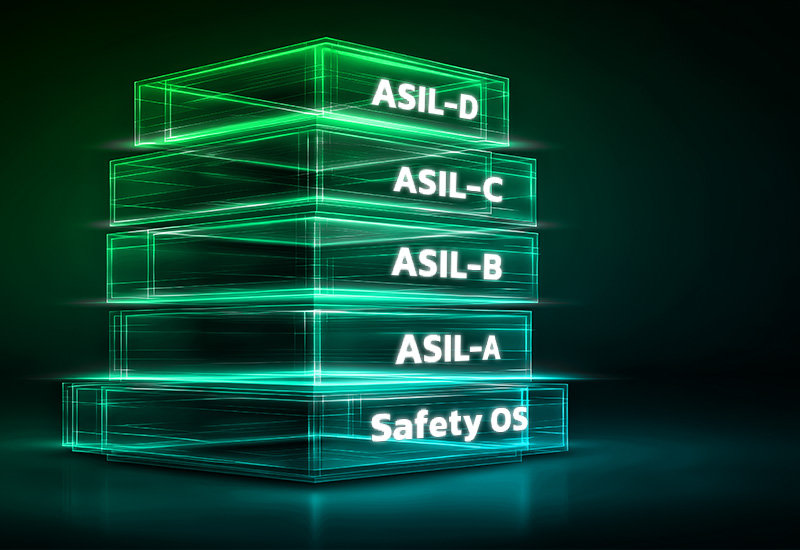
Systematically address safety requirements
Use software components developed for safety scenarios instead of creating every mechanism from scratch.

Reduce integration uncertainty
Build on proven automotive software components and integration approaches to reduce late architectural surprises.

Prepare for higher safety availability
Establish building blocks that support the transition from fail-safe architectures to fail-operational concepts.
A clearer path from safety requirement to implementation
01
Translate safety requirements
Understand safety goals, ASIL requirements, dependencies, and architectural constraints.
02
Build with proven safety components
Use appropriate safety OS, middleware, and established mechanisms for the use case.
03
Integrate, verify, and scale
Build an architecture that remains maintainable as ECU functionality and safety demands grow.
ASIL requirementsSafety software building blocksFail-safe architecturePath toward fail-operational
Make functional safety easier to manage across the ECU lifecycle
Outcomes
Fewer late safety surprises
Address critical architectural and safety considerations earlier instead of finding avoidable gaps near SOP.
Less unnecessary re-engineering
Build on established components and patterns instead of repeatedly solving known problems.
A scalable foundation
Create an approach designed to support demanding safety applications as architectures evolve.
Proven in real automotive programs
Customer testimonials
“
With our software and services, JLR accelerates next-generation production now and on their future platforms, achieving safer, more reliable ECUs while cutting time and hidden costs.
“
A centralized ECU architecture and software platform unlocked hardware potential, boosting efficiency and enabling lifecycle updates in current and future platform releases while strengthening safety and security.
“
Pre-integrated Classic AUTOSAR simplified ECU software implementation, secured safety compliance, and cut integration complexity and costs, supporting current programs and future platforms alike.
Why leading car manufacturers rely on us
Why Elektrobit?
01
Pioneer in ASIL-D certification
Back in 2013, we launched the first ASIL-D-certified operating system on the market.
02
Full-stack certification
Our complete software stack has been certified for Freedom from Interference (FFI).
03
No vendor lock-in
Our solutions can be used flexibly and adapt to existing architectures.
04
ISO 26262 experience from the start
Working on safety projects since before the ISO standard, with continued support for the current ISO 26262:2018 edition.
05
Scalable
From ASIL-B to ASIL-D. From individual systems to complete vehicle platforms.
06
92% return rate
The majority of our customers want to work with us again after the first project.
Questions before you watch?
FAQ
Is this relevant if I already work with ISO 26262?
Yes. The session goes beyond a basic introduction and focuses on practical software building blocks, Classic AUTOSAR safety implementation, and the progression from fail-safe toward fail-operational architectures.
Does the webinar cover ASIL-D?
It discusses how safety operating systems and established building blocks can address use cases up to ASIL-C and ASIL-D.
Is this only relevant for new ECU projects?
No. The principles also apply when evolving an existing architecture, consolidating functionality, or evaluating software building blocks for future ECU generations.
Does a certified component automatically make my ECU ISO 26262 compliant?
No. Functional safety applies to the overall system and development process. Certified components can support parts of the implementation and safety argument, but do not automatically certify the complete ECU.
Is the webinar only about fail-safe systems?
No. It starts with fail-safe implementation and explores how similar building blocks can support the progression toward fail-operational systems.
See how experienced safety teams approach the problem
On-demand webinar
Watch Turning safety challenges into the path to autonomous safety and learn how to structure functional safety implementation using proven building blocks.
To display this form, content from our Salesforce service provider Pardot must be loaded. You can allow Pardot content for this form only or for all Pardot forms on our website. For more privacy information check Privacy policy – Elektrobit.