AI meets automotive software: making complex SDVs simple to explore
Imagine a developer starting their day with a fresh project in a software-defined vehicle (SDV) environment. Before artificial intelligence (AI) and Eclipse Ankaios, their morning might begin with a stack of manuals, endless configuration files, and the daunting task of manually setting up multiple interdependent workloads. Each mistake could mean hours of debugging and rethinking the setup. It is meticulous, slow work, and the first encounter with new tools often feels frustrating and opaque.
Now, picture the same developer facing that same project, but this time with an AI-powered assistant at their side. With the help of an LMOS-powered developer interface and Eclipse Ankaios, the experience is completely transformed.
Instead of poring over documentation or guessing the effects of a configuration change, the developer chats naturally with the system. The AI guides them through cluster setup, workload orchestration, and dynamic reconfiguration as if they were asking a colleague for advice. Suddenly, complex concepts feel intuitive, and experimentation is fast and forgiving.
Artificial intelligence has reshaped the way we develop, deploy, and manage software-defined vehicles. By integrating an LMOS-powered large language model interface with Ankaios, an embedded workload orchestrator, developers and architects are enabled to learn and explore in-vehicle software management in a conversational, intuitive way. This combination allows even intricate orchestration tasks to be approached naturally, lowering the learning curve and speeding up innovation.

What is Eclipse Ankaios?
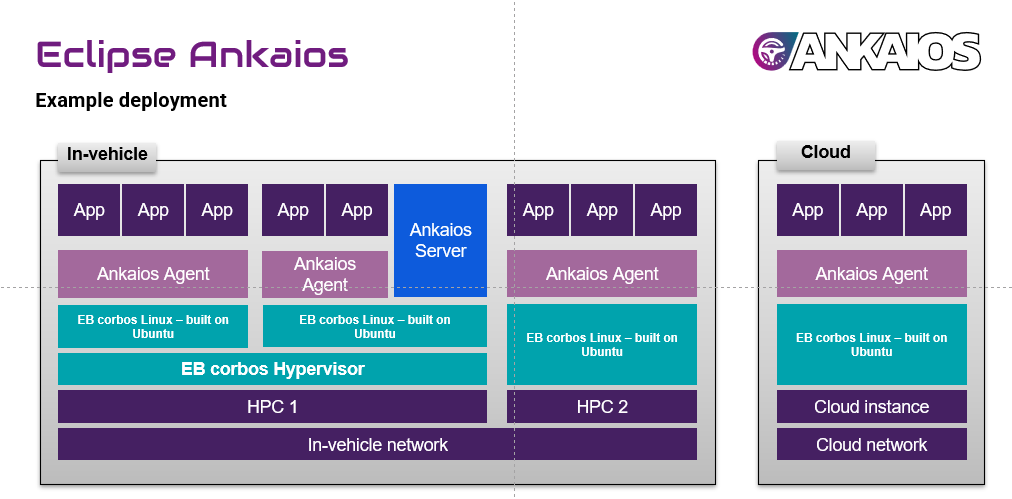
Eclipse Ankaios is designed specifically for embedded and automotive environments, it is a lightweight, resource-efficient container and workload orchestrator. Ankaios manages distributed applications with attention to startup dependencies, eventual consistency, and workload failovers and restarts.
Its declarative setup and configuration sharing make it well-suited for complex software landscapes, particularly high-performance computers. In essence, Ankaios provides a foundation for next-generation SDVs, built to support the needs of developers without overwhelming them with complexity.
What is Eclipse LMOS?
The Eclipse Language Model Operating System (LMOS), takes the power of AI and makes it actionable. LMOS is an open-source platform for building and running AI agents, acting like an operating system for agents by managing communication, memory, and orchestration on top of cloud-native tools like Kubernetes and Istio.
Its natural-language-inspired ARC domain-specific language simplifies the creation of AI agents while enabling scalable, secure, and interoperable systems. The goal is ambitious: to power an open, decentralized “Internet of Agents” that can handle complex tasks across multiple domains.
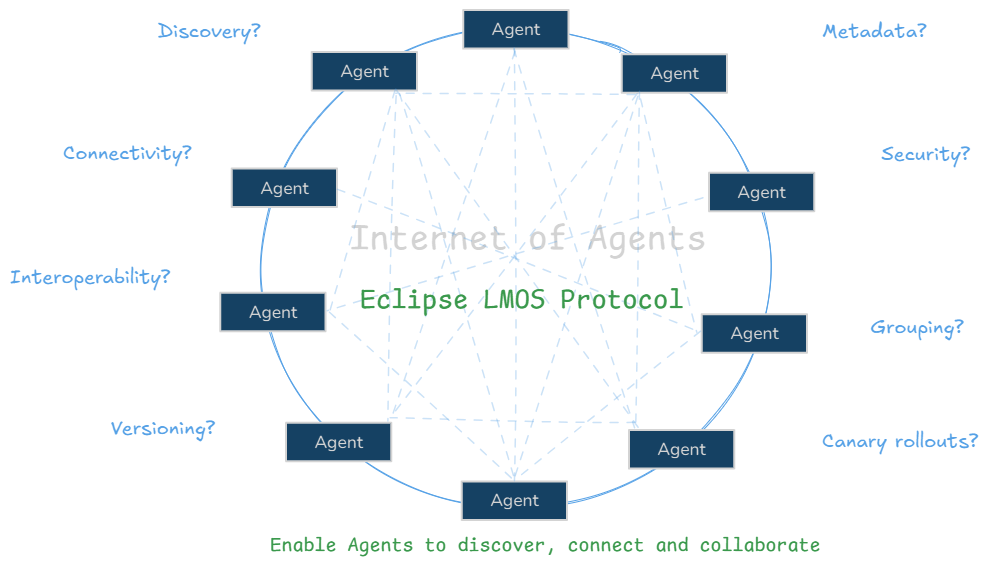
Source: Eclipse LMOS documentation
From manual struggle to conversational ease
Returning to our developer’s day, the contrast is clear. Without Ankaios and AI, they wrestle with manually setting up the environment, tracking node and workload states, and troubleshooting configuration errors. Every step is slow, every misstep – costly. With the Ankaios and the AI-powered sandbox, the workflow changes completely.
The developer can:
- Set up a cluster composed of any number of agents with a simple conversation.
- Inspect the full state of the cluster, including nodes and workloads.
- Modify configurations on the fly, adding or removing workloads as needed.
- Shut down and clean up the environment effortlessly.
All of this happens with friendly guidance and subtle warnings, helping prevent mistakes and ensuring a smooth experience. It is learning by doing, without fear of breaking something critical, and it turns what was once a stressful, technical slog into an intuitive process that feels natural.
Extending the approach beyond automotive
The potential of this approach extends well beyond single tools or even SDVs. AI-powered sandboxes could lower barriers in fields like robotics, internet of things (IoT), and cloud infrastructure, where complexity often slows progress. By creating conversational interfaces that guide exploration, users can prototype faster, experiment safely, and quickly understand underlying systems as if they have become experts overnight.
The Eclipse SDV Community Days demonstrated this effectively, with attendees quickly engaging, experimenting, and gaining insights they might have struggled to achieve manually.
Benefits and challenges
AI-enhanced tool sandboxes offer several clear benefits. They improve efficiency by enabling integrators and developers to easily write detailed configurations. They enhance accessibility, allowing non-experts to engage meaningfully with complex systems. Productivity increases because developers can iterate faster, exploring ideas without getting stuck on setup or debugging. And perhaps most importantly, user experience improves dramatically, with AI providing a conversational and supportive interface.
However, challenges remain. In safety-critical domains like automotive software, AI actions and responses must remain reliable, context-aware, and predictable. While current systems are improving rapidly, developers and architects must continue to ensure that AI-driven tools operate safely and consistently. Human oversight will remain crucial.
Looking ahead: AI in SDV development
The example of an AI-powered Ankaios sandbox is just the beginning. As agentic AI evolves, its reliability and determinism improve, opening the door to new applications across software-defined vehicles and beyond. The ability to explore, learn, and experiment with complex systems through natural conversation promises to transform not only development workflows but the way people engage with technology itself.
From struggle to simplicity
The day in the life of a developer illustrates the power of AI in practice. By turning what was once a painstaking process into an intuitive, guided experience, Ankaios and LMOS bridge the gap between human intent and technical execution. Whether setting up clusters, testing new configurations, or exploring SDV concepts, the combination of Ankaios and AI transforms learning and exploration into a friendly, accessible, and efficient process.
The future of automotive software development will be shaped not just by the tools we build, but also by how easily humans can engage with them. Explore the possibilities of AI-enhanced SDV software with Eclipse LMOS and Ankaios, and see how conversational intelligence unlocks innovation.
For further information, please check out these other valuable resources:
- Eclipse Ankaios explained:https://youtu.be/KEYoGnzucG0?si=UT2MIBpRpWVtTQcV
- Eclipse Ankaios blog:https://www.elektrobit.com/blog/managing-automotive-hpc-software-complexity-with-eclipse-ankaios/
- Hear from the author, Kaloyan Rusev:https://youtu.be/6t4IoP55qa0?si=yl6tZa5vJI16xAuo
- Eclipse Ankaios resources:https://eclipse-ankaios.github.io/ankaios/latest/usage/awesome-ankaios/
Author

Kaloyan Rusev
Senior Architect


