Reading time
7 minutes
Advanced software is revolutionizing the global automotive industry, making cars more personalized, more intelligent, more autonomous, and safer. Today’s vehicle designs may include more than 100 electric control units, or ECUs. These embedded software systems autonomously monitor and control systems like the engine, transmission, brakes, airbags, and lighting.
As they receive real-time, continuous data inputs from sensors positioned throughout the vehicle, ECUs use sophisticated algorithms to make instant, informed decisions. They also ensure all systems and components are working together seamlessly, alerting drivers to any issues. The addition of real-time intelligence is a critical inflection point in the automotive industry, dramatically improving safety, efficiency, responsiveness, and the overall consumer driving experience.
As competition heats up in the worldwide auto market, manufacturers increasingly differentiate themselves based on software features and embedded systems. Carmakers are pressured to deliver a constant stream of configurable, on-demand features and functionality — which consumers can choose and download like smartphone apps. Manufacturers also must provide seamless, automatic software updates via the cloud for the life of the vehicle.
As they focus on innovation, automakers need to balance rapid development and flexible deployment with unfailing reliability and safety standards. Engineers face additional challenges, including increasing software complexity, tight coupling of hardware and software, and high validation costs.
The Solution Is Clear: Software First
The path forward is obvious: Leading engineering teams are shifting from a hardware-centric development approach to a new paradigm in which software is prioritized. This emerging paradigm is supported by scalable platforms, continuous integration, continuous deployment, and robust cybersecurity frameworks.
Pioneered by Cognizant, an Elektrobit partner, this approach has four defining characteristics:
- Cloud-native design, testing, and deployment before software is installed in a vehicle
- A cloud-to-edge software architecture that distributes workloads dynamically between the car and the cloud
- An automotive DevOps process that manages development, integration, and operations in a single, continuous pipeline
- A service-oriented, portable architecture that enables a “write once, run everywhere” capability
Elektrobit and Cognizant: Making the Impossible Possible
This ambitious vision of fast, safe, cost-effective, software-led innovation may seem impossible to achieve at first glance. But the global auto industry has defined a shared standard for engineering modular, service-oriented Software-Defined Vehicle (SDV) architectures.
The Scalable Open Architecture for Embedded Edge, or SOAFEE, standard has been collaboratively defined by automakers, semiconductor suppliers, open source and independent software vendors, and technology leaders like Elektrobit and Cognizant. While SOAFEE provides a general roadmap, automotive engineering teams still need a proven method, and best practices, to successfully adopt this standard.
That’s where Elektrobit’s partnership with Cognizant adds significant value. Cognizant is leading in SDV architecture development by combining the universal SOAFEE standard with its own advanced, AI-driven analytics. Cognizant’s unique SDV blueprint includes the use of Elektrobit’s EB corbos AdaptiveCore, the software base for safe and secure high-performance ECUs. It provides a holistic software framework according to the automotive industry’s AUTOSAR Adaptive Platform.
Why are high-performance controllers so critical for software-defined vehicles? As cars become more interconnected, autonomous, and intelligent, high-performance computing capabilities are essential for ECUs. Today high-performance ECUs form the computing backbone of the software-defined vehicle. EB corbos AdaptiveCore provides the full set of building blocks to define a software-first, tightly controlled, and flawlessly designed electronic architecture.
Cognizant’s SDV blueprint also leverages EB corbos AdaptiveCore middleware for standardized, reliable data exchange. As ECUs gather enormous volumes of real-time data, EB corbos AdaptiveCore easily integrates with multiple applications across the vehicle, following the AUTOSAR Adaptive Platform methodology.
A Case in Point: Monitoring Tire Pressure
One real-world application for this high-performance data exchange capability is real-time monitoring of tire health. As EB corbos AdaptiveCore gathers data on tire wear, temperature, miles traveled, and other performance factors, AI-enabled ECUs apply predictive analytics to reduce downtime, optimize fuel consumption, maximize safety, and alert the driver of the need for repair or maintenance.
This innovative tire pressure monitoring system (TPMS) is built on communications protocols defined collaboratively by Elektrobit and Cognizant (shown below). A service-oriented software architecture enables real-time, modular, and scalable processing of sensor data from each wheel.
To maintain compatibility with legacy automotive systems, the Elektrobit-Cognizant TPMS architecture supports traditional signal-based communication protocols such as CAN (Controller Area Network) and LIN (Local Interconnect Network). These protocols are used to transmit raw sensor signals from the TPMS hardware to the edge gateway, where they are abstracted into service messages. EB corbos AdaptiveCore acts as a translation layer, converting these low-level signals into structured service payloads, enabling seamless integration with modern cloud-native components.
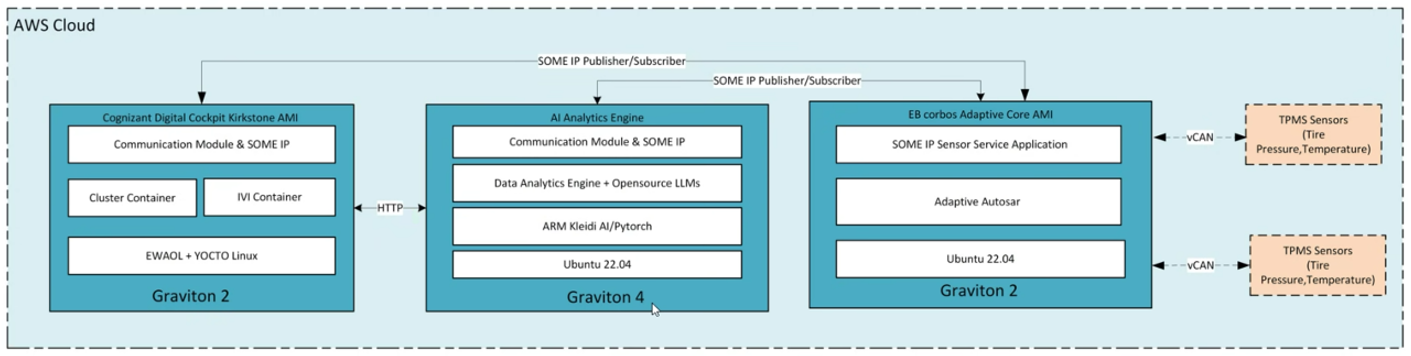
The result is an intelligent, scalable, and cost-effective TPMS solution that delivers real-time insights, predictive maintenance alerts, and comprehensive reports — fully optimized for modern cloud infrastructures. Tire pressure, temperature, and wear metrics are streamed continuously, ensuring low latency, reliable communication between components, and early warnings that maximize passenger safety.
Design a More Innovative Future
By adopting Cognizant’s SDV blueprint, including EB corbos AdaptiveCore, the world’s auto manufacturers and their Tier 1 suppliers can innovate rapidly and continuously, without long development timelines and cost overruns — and without compromising software engineering rigor.
Elektrobit’s partnership with Cognizant is just one way we’re helping automakers keep pace with technology advancements and differentiate themselves in an increasingly crowded marketplace.
From initial concept to standard operating procedure, we specialize in supporting safety-critical and security-related ECUs, leveraging our global network of engineers with extensive experience in Adaptive AUTOSAR and open-source development. Count on Elektrobit to deliver dependable solutions tailored to your specific needs, backed by a legacy of success. Contact us today to learn more about how we can.
You can also learn more about Cognizant’s SDV blueprint by reading this blog that was recently published on the SOAFEE website.
Author

Amol Gulve
SDV and AI Offering Leader at Cognizant

Sorin Zamfir
Product Manager for Cloud and Systems at Elektrobit


