Shaping its future in the automotive sector
The system-theoretic process analysis (STPA) has already been successfully applied in several domains. However, it has not yet arrived in the automotive industry. To do so, it’s practical application in all automotive contexts needs to be clarified in detail, especially when it comes to existing safety standards and goals.
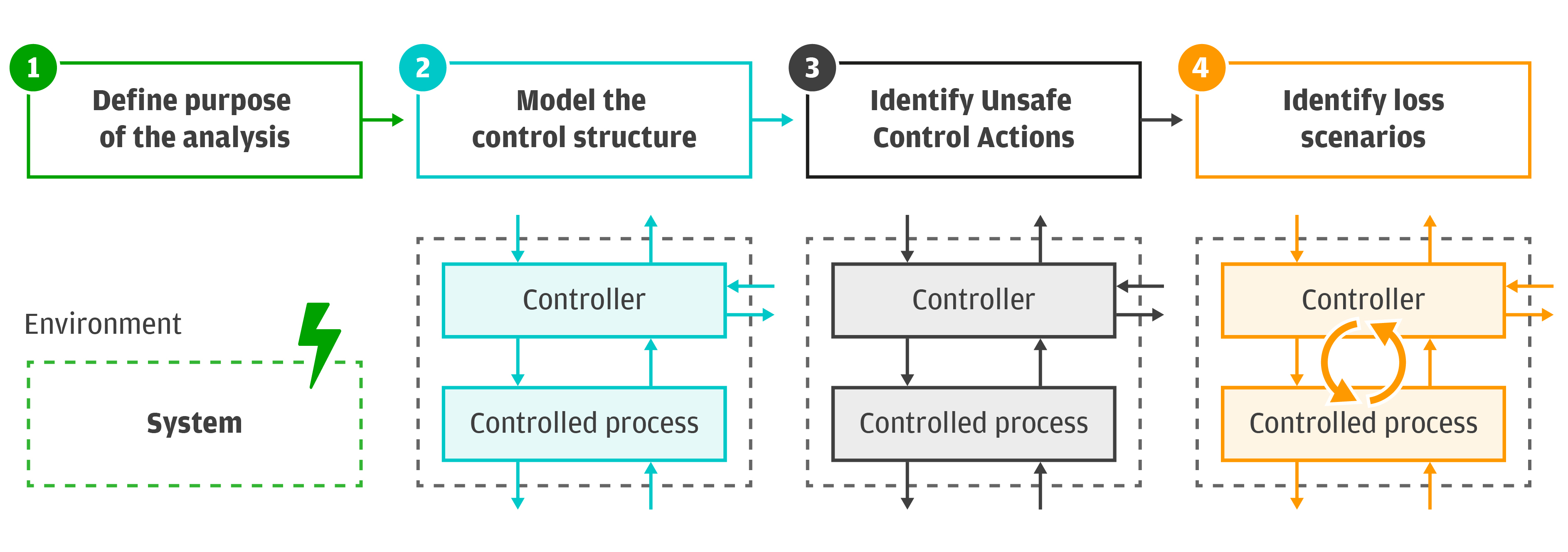
Crucial points for clarification:
- Where are the connecting similarities between STPA and the work products required by ISO?
Quite obvious examples are the Unsafe Control Actions and the Safety Constraints which are outputs of the STPA approach. Those outputs could be used as input for defining the safety requirements according to the ISO 26262. - Is it really sufficient to restrict the use of safety methods like STPA to the product development process? Shouldn’t the entire product lifecycle be considered?
Nowadays, caring about safety shouldn’t stop at the end of the product development. Examples like the Boing 737 Max accident show that there are a lot more parameters which should be considered. The pilots did not know anything about the system which led to the accident. When not knowing anything about a system, how should one know how to deal with system’s failure the right way? In this case, considering required trainings or parts of the use manual in the control structure would maybe have prevented these terrifying accidents. Besides, there should be other useful extensions to the existing control structure approach to make it an even more holistic one. - In which way should the application of STPA be linked to the architecture design process and the respective required decisions?
To model the control structure, within STPA, architectural knowledge is required from the very beginning. For this purpose and for other functional safety activities, architects and safety officers should be strongly connected. But, currently, a lack of communication between architects and safety managers or safety engineers can be observed quite often. The underlying processes should emphasize more on that. - How to integrate the STPA approach into the product development process according to V-Model and how to deal with the iterative character of the STPA approach in an agile way?
What about the connection to other parties except the architects? The STPA process itself is of iterative nature. It is supposed to refine the control structure iteratively during the whole product development. Therefore, the STPA approach should be well mappable to agile approaches. But, as many know, especially the automotive industry is mostly working according to the V-model approach. If you want to know how to align STPA, agility, and the V-model with each other, get in touch with us.


