
Reading time
6 minutes
The automotive industry is entering a new phase where software defines differentiation, lifecycle value, and customer experience. With Android Automotive OS for Software-Defined Vehicles (AAOS SDV), Google is extending its proven infotainment platform into a broader, scalable vehicle software foundation. This evolution creates new opportunities across in-vehicle infotainment (IVI), high-performance computing (HPC), and real-time control (RTC), while also reshaping how software teams develop, integrate, and operate vehicle platforms.
For OEM executives, program leaders, and developers alike, AAOS SDV is not just a technology step—it is a strategic enabler for reducing complexity, accelerating programs, and unlocking continuous innovation.

The consolidation of cockpit domains throughout IVI, HPC, and RTC advances with AAOS SDV.
A unified software foundation for the entire vehicle
AAOS SDV addresses one of the most persistent challenges in the industry: fragmented software stacks across domains and ECUs. It introduces a modular, service-oriented platform with a topology-agnostic communication layer and support for granular updates, enabling a consistent software backbone across the vehicle.
Instead of treating IVI, cluster, and body domains as isolated systems, AAOS SDV extends a lightweight, headless Android-based stack deep into the vehicle architecture. It is designed to power a wide range of components, from cockpit displays to climate control and telemetry, while providing standardized frameworks for communication, diagnostics, and software updates.

AAOS SDV reduces complexity of comprehensive HMI development.
For OEM decision makers, this translates into reduced integration effort, improved reuse of software components, and a consistent development paradigm across vehicle programs. For developers, it means working with a unified architecture that eliminates redundant implementations and simplifies cross-domain collaboration. At the same time, the architecture leaves the flexibility to the projects to decide about the technical implementations of some of the key components e.g. SOME/IP.
Opportunities across IVI, HPC, and RTC
IVI: from differentiation to continuous experience evolution
AAOS has already established itself as a strong foundation for IVI systems. With AAOS SDV, IVI becomes an integral part of a broader, service-oriented vehicle platform, rather than a standalone domain.
The introduction of frameworks such as Display Safety allows OEMs to integrate instrument cluster functionality, including safety-relevant visuals and alerts, alongside a rich infotainment experience within a cohesive environment. At the same time, the service-oriented architecture enables updates at the level of individual vehicle functions, allowing features to be deployed and improved continuously over the air.
For business leaders, this enables a shift from one-time feature launches to continuous value delivery over the vehicle lifecycle. For development teams, it introduces a modern application and service model that supports faster iteration cycles, modular feature development, and more efficient reuse across programs.
HPC: enabling centralized compute and cloud-driven development
AAOS SDV is designed for modern centralized vehicle architectures. It supports both hypervisor-based virtualization and bare-metal deployment, allowing OEMs to adapt the platform to different performance and isolation requirements.
Equally important is its strong alignment with cloud-based development workflows. AAOS SDV supports virtual development environments and digital twin concepts, enabling teams to design, test, and validate vehicle software well before physical hardware is available.
For executives and program managers, this reduces development risk and shortens time to market. For developers, it fundamentally changes the workflow: instead of relying on late-stage hardware testing, they can iterate rapidly in virtual environments, automate validation pipelines, and integrate continuously across distributed teams.
RTC: bridging service-oriented platforms with real-time control
As AAOS SDV expands beyond infotainment into vehicle control domains, the interaction with real-time and safety-critical systems becomes essential. The platform supports low-latency deployments and includes frameworks for diagnostics, communication, and control.
This creates a bridge between high-level application software and traditional embedded control systems. The result is a more integrated architecture where data and services can flow across domains without rigid boundaries.
For OEMs, this opens the path to consolidating ECUs and reducing system complexity. For developers, it enables closer alignment between application and control logic, while still requiring structured approaches to safety separation and determinism.
Elektrobit enables production-grade SDV architectures
AAOS SDV provides a strong open foundation, but OEMs still need production-ready solutions to meet requirements for safety, scalability, and lifecycle management. Elektrobit complements this platform with solutions that connect innovation with industrialization. Our unmatched cockpit HMI expertise with Android Automotive culminate in EB civion, empowering OEMs to drastically accelerate and scale cockpit projects.
EB civion: Enhancing IVI development and cockpit integration
EB civion extends AAOS SDV capabilities in the cockpit domain by delivering a production-ready software stack for IVI and digital cockpit systems. It adds advanced human-machine interface frameworks and integration expertise tailored to Android-based environments.
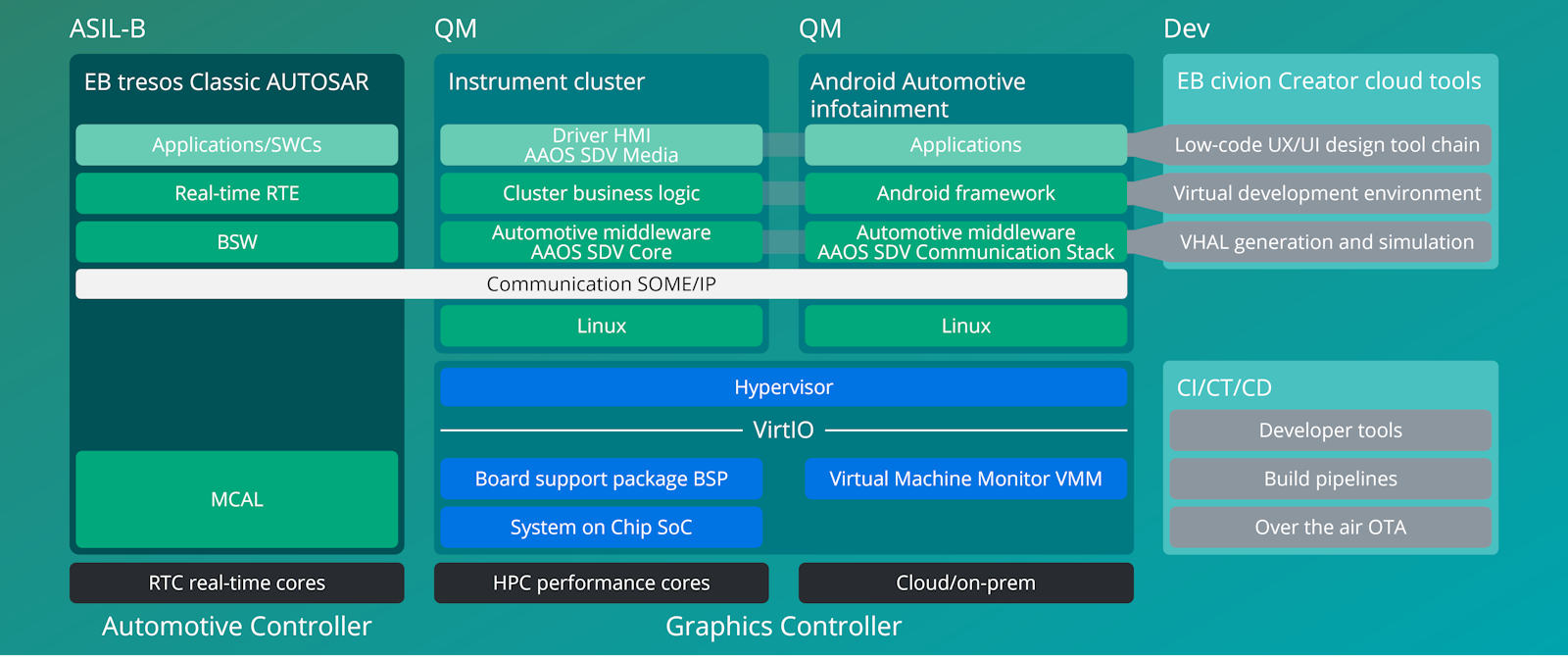
Utilizing the AAOS SDV architecture, EB civion enables OEMs to implement consistent user experiences across infotainment and cluster while reducing integration complexity. For developers, it provides pre-integrated building blocks and mature tooling, which accelerates implementation and reduces project risk.
Conclusion: From platform to competitive advantage
AAOS SDV transforms Android Automotive OS into a comprehensive vehicle software platform that spans IVI, HPC, and RTC. In combination with solutions like EB civion, its modular, service-oriented design reduces complexity and enables continuous innovation across the vehicle lifecycle.
For decision makers, this means transitioning from fragmented, proprietary development to platform-driven value creation. For project managers, it reduces integration risk and improves predictability. For developers, it delivers a modern software environment with reusable services, cloud-native workflows, and clear separation of concerns across domains.
When combined with EB civion and EB corbos Linux for Safety Applications, this platform becomes production-ready, bridging innovation with safety and scalability. The result is a unified SDV architecture that aligns business strategy and developer execution.
For OEMs, this is the key shift: software is no longer just a cost factor. It becomes a controlled, extensible, and continuously evolving asset that drives long-term competitive advantage.
Contact us to discuss how AAOS SDV and Elektrobit can help you accelerate your software-defined vehicle cockpit development.
Author

Huzaifa Saadat
Product Manager

Venkatesh Prakash
Business Solution Architect


