
Reading time
4-5 minutes
In May 2026, I had the opportunity to join industry peers in Stuttgart for the European AI and Software-Defined Vehicle Summit – a focused event bringing together OEMs, suppliers, and technology leaders to discuss how AI and software are reshaping the automotive industry.
With participants from companies such as BMW, JLR, Bosch, AWS, and Microsoft, the discussions were not theoretical – they were grounded in real transformation challenges and decisions the industry is facing today.
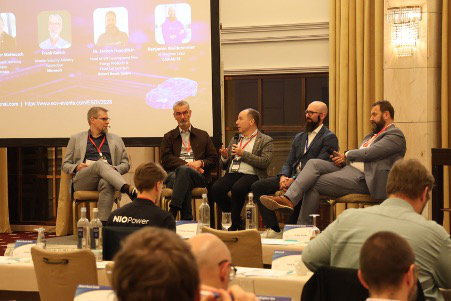
At the summit, I contributed both with a keynote on “Open Source, Safety, AI, and SDV: the pathway to cost-efficient vehicle software architecture” and as a panelist in the discussion on “Designing Cars in the Cloud: Virtual Twins, Synthetic Data and AI”.
A shift I see clearly: from vehicles to platforms
One message came through consistently across sessions:
we are moving from vehicle-centric development to platform-centric thinking.
OEMs are increasingly restructuring their architectures by separating stable, safety-critical domains such as powertrain and chassis from fast-moving, software-driven domains like cockpit, AI, and infotainment. This approach enables faster innovation cycles while maintaining safety – but it also introduces a new level of integration complexity.
From my perspective, this reinforces a key point:
Success in SDV is not about building everything new – it is about managing complexity intelligently.
My keynote: why cost efficiency starts with reuse
In my keynote, I focused on a principle that is simple – but often overlooked:
We should not reinvent what already exists.
Instead of rebuilding complete software stacks, we need to make more deliberate architectural decisions. This includes right-sizing SDV architectures based on actual value creation, reusing proven technologies wherever possible, and building on open-source foundations. At the same time, these approaches must be combined with robust safety concepts and increasingly AI-driven development practices.
What I continue to observe across the industry is a tendency to overengineer – trying to “do SDV everywhere.” This inevitably leads to higher costs and slower execution.
A more effective approach is to focus SDV capabilities where they create real differentiation, while leveraging existing solutions for everything else.
The growing tension: customization vs. scalability
Another theme that stood out clearly is the growing tension between customization and scalability.
OEMs are increasingly aiming for full control and differentiation, often expecting tailored solutions. At the same time, suppliers are under pressure to scale their business through reusable and standardized software components. Both perspectives are valid – but together they are driving fragmentation.
Looking ahead, this makes one development very likely:
we will see a renewed push toward standardization – this time at a higher level of abstraction.
Open source and safety: moving beyond the debate
The role of open-source software in safety-critical systems has evolved significantly.
The discussion is no longer about whether open source can be used, but how it can be applied effectively and qualified systematically. From what I have seen, open source provides a strong and proven foundation. When combined with structured safety approaches and appropriate system design, it becomes a powerful enabler.
Open source and safety are not conflicting goals – they reinforce each other.
This combination is one of the most effective ways to improve both development speed and overall cost efficiency in SDV programs.
AI: the biggest shift is organizational, not technical
AI was present in almost every discussion – but the most important takeaway goes beyond the technology itself:
AI will not transform our industry through tools alone.
What stood out in particular is the shift toward agent-based development approaches and end-to-end AI-supported workflows. Instead of isolated assistants, the focus is moving toward integrating AI across the entire lifecycle – from requirements to integration and validation.
This has a direct implication: organizations need to adapt how they work. AI becomes impactful only when it is embedded holistically, supported by accessible data and consistent processes.
In my view, this is where the real transformation will happen.
What stood out in the discussions
Across sessions – and particularly in panel exchanges – a consistent picture emerged.
There is broad agreement that SDV programs are significantly more complex than many initially expected, especially when it comes to system integration. At the same time, it became clear that scale can only be achieved through closer collaboration across the ecosystem. AI, while promising, depends heavily on data accessibility and organizational readiness.
At the same time, differences in priorities remain visible. OEMs tend to focus on control and differentiation, while suppliers emphasize reuse and scalability.
For me, this highlights a fundamental challenge:
We are building the same ecosystem – but often optimizing for different outcomes.
Bridging this gap will be essential to move from experimentation to industrial-scale SDV deployment.
A reminder worth repeating: technology must serve the user
Amid all the technical depth, one insight stood out clearly:
Customers don’t buy technology – they buy better experiences.
This means that complexity must remain invisible.
From an architectural perspective, this requires more discipline. Not every system needs maximum flexibility, and not every ECU needs full SDV capabilities. Instead, decisions should be driven by where technology creates tangible, visible value for the end user.
Right-sizing solutions is key to balancing innovation and efficiency.
Regulation is accelerating – and raising the bar
Another important dimension is the regulatory landscape, which is evolving quickly with initiatives such as the EU AI Act and the updated Product Liability Directive.
These developments fundamentally change the context in which we operate. Software and AI are now clearly treated as products, with associated liability implications. As a result, requirements for traceability, documentation, and quality are increasing significantly.
The conclusion is straightforward:
Speed remains important – but it must be balanced with robustness and accountability.
What I take away from Stuttgart
Reflecting on the summit, a few clear directions emerge:
- Scale requires reuse and standardization
- Open source is becoming a cornerstone in modern SDV architectures
- AI will reshape development – but only with holistic adoption
- Architecture decisions will define business outcomes
My perspective going forward
For me, the direction is clear.
We need to reuse as much as possible, build on open ecosystems, and apply safety systematically. At the same time, AI should be used to reduce integration complexity – not to add new layers of it.
This is how we can make software-defined vehicles scalable, cost-efficient, and ready for real-world deployment.
Author

Dr. Alexander Mattausch
Chief Expert Software Architecture


