
Reading time
5 minutes
While May brings the promise of summer, there is also a certain type of “forceful” energy that is present throughout the month. In a galaxy not so far away, the paradigms of automotive software and specifically how vehicle functions are being engineered are changing. In the era of the software-defined vehicle (SDV) with advanced driver assistance systems (ADAS) being a critical component of the vehicle experience – and as the industry moves toward autonomous driving – the traditional approach of performing safety exclusively on real-time cores is no longer viable.
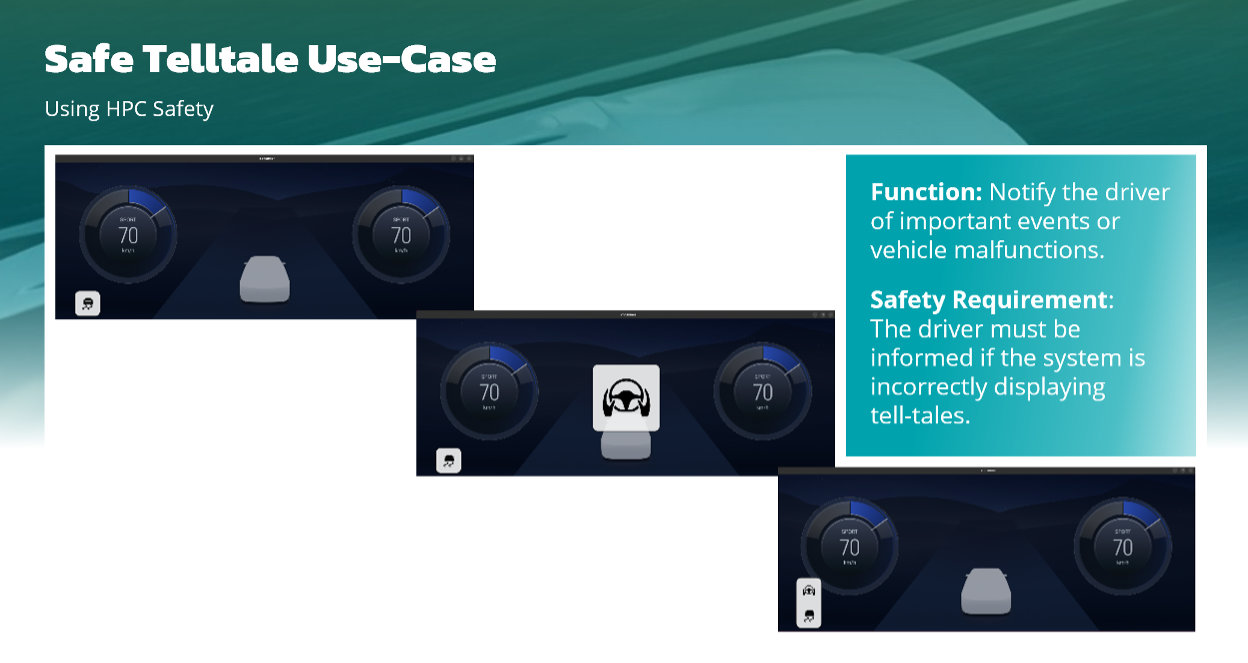
Many confuse availability and functional safety. If your digital side-mirror turns off completely, that is an availability failure. You, the driver, know it’s broken and can pull over. But if the mirror stays on and looks like it’s working, yet, fails to show the car in your blind spot, that is a functional safety failure. It’s a subtle, potentially catastrophic mistake, much like a Jedi mind trick: everything looks normal, but the underlying reality is dangerously different.
To understand where we are going, we must understand the pillars of the modern automotive software revolution – high-performance compute (HPC), the realities and misconceptions around open source, the critical need for a new safety net approach, and cybersecurity.
The Shift to HPC: Beyond the Microcontroller
For decades, automotive software lived in a world of simplicity. Functional safety was traditionally managed in a microcontroller setting, simple computers with basic operating systems designed to do one thing very well. You had an ignition module or a motor control module; they took electrical inputs, processed them through a feedback loop and spit out electrical outputs.
But as we move towards autonomous driving, we are replacing the human driver. Humans are remarkably similar to high-performance PCs – we have incredible compute throughput and can process complex, unstructured data, even if our latency (reaction time) is slower than a dedicated machine.
To replicate this, the industry must transition from deeply embedded devices to a HPC paradigm. Deeply embedded devices are excellent at millisecond-level real-time tasks, like measuring piston displacement and opening valves, but they lack the sheer brainpower required for complex ADAS functions. If you want your car to recognize a pedestrian, navigate a complex intersection and update its maps in real-time, you need the power of a PC, not just a microcontroller.
The Illusion of Safety: Why Making Linux Safe is the Wrong Goal
As the need for compute grows, so is the opportunity for new approaches such as leveraging open source and Linux for automotive safety applications.
Many in the industry have spent years trying to make Linux safe by stripping it down or attempting to certify the entire kernel. The Linux kernel is too vast, too dynamic and too far outside any single company’s control to be made safe in the traditional sense.
The Trapeze Artist and the Safety Net: A Novel Approach
So, how do we use the best open-source software without compromising safety?
Think of Linux as the world’s greatest trapeze artist. They are incredibly talented, versatile and high performing. You want them in your circus (your car) because they provide the best show (the best features). However, would you ever trust that they, or any human being, will never fall? Of course not.
Instead of trying to engineer the trapeze artist to be infallible, the smart circus director installs a safety net. It is far easier to certify the safety of the net and its anchors than it is to certify the biology of the artist.
With EB corbos Linux for Safety Applications, Linux is the trapeze artist. It runs the complex, high-compute applications. A separate Operating System Monitor acts as the safety net, by detecting any interference by the unsafe Linux kernel with the application’s safe operation, potentially leading to a catastrophic event. This approach allows automotive OEMs and Tier 1 suppliers to maintain the speed and innovation of open source while keeping the vehicle’s anchors, the safety-critical functions, firmly under their control.

Cybersecurity: The Hidden Side of the Force
You cannot talk about HPC without talking about cybersecurity. Moving to a centralized, connected computer creates a single, highly visible point of attack. Unlike the esoterica of old microcontrollers, modern automotive systems are now familiar to everyone.
The old automotive way was security through obscurity, hiding the complexity and hoping no one found the flaws. But obscurity is like a swamp: it might look pretty on the surface, but the moment you fall in, you realize how ugly it is underneath.

Open source offers a better path: security through transparency. By using a transparent stack, the community can see exactly what is under the surface. At Elektrobit, through our partnership with Canonical, we are bringing 15 years of cybersecurity maintenance to the automotive world, ensuring that the force of the community is constantly working to patch vulnerabilities and keep the stack secure.

Avoiding the Dark Side
The ultimate lesson is one of control. If you don’t control your software stack, you are at the mercy of those who do. We’ve seen what happens when hardware manufacturers rely on proprietary, black box operating systems: a single glitch in a background process, like an autoimmune response from a virus scanner can brick an entire device. In a handheld gaming device, that’s a nuisance; in a 4,000-pound vehicle at highway speeds, it’s unacceptable.
By embracing an open-source architecture, like EB corbos Linux for Safety Applications, with a dedicated safety net, automotive OEMs can share the massive investment of software development with a global community while retaining total control over their vehicle’s safety and soul.
The SDV is no longer a future concept; it is an industry mandate. The challenge has shifted from if to how – how to scale it, how to industrialize it and how to make it accessible across all market segments. By selecting the right architecture, you don’t have to choose between innovation, accessibility and safety. You can have it all.
Interested in diving deeper into Linux without boundaries and why it’s time to change the running system? Check out our latest webinar where we explore the next phase of the open-source rebellion.
May the force – and source – be with you.
Author

Isaac Trefz
Senior Product Manager, HPC Solutions


