- SDV
- |
- Open-source software
Open-source software powering the future of SDV
Enabling safe, scalable, and efficient SDV development through open-source technologies and decades of embedded automotive expertise
Open source has become the engine of modern innovation – powering everything from cloud platforms to mobile devices. In the automotive industry, it offers a way to accelerate development, reduce costs, and benefit from a shared ecosystem of tools, standards, and best practices. But automotive software comes with unique challenges: long product life cycles, constrained compute environments, and strict safety and security requirements. Open-source adoption in this space must go beyond reuse – it requires adaptation, validation, and long-term support. When done right, open source helps automotive companies build smarter, safer, and more future-proof vehicles.
At Elektrobit, our open-source software governance is conformant to the OpenChain Project standard (ISO/IEC 5230) — the global benchmark for open-source licensing, supply-chain transparency and compliance. This reinforces our commitment to trustworthy software, predictable risk management and open-ecosystem collaboration in the automotive space.
Establishing new standards through open collaboration
From the outset, we have contributed to open-source projects in the automotive industry, including Eclipse Software Defined Vehicle (Eclipse SDV), Connected Vehicle Systems Alliance (COVESA) and Automotive Grade Linux (AGL).
Interoperability by design
Seamless integration made easy through open interfaces and modular architectures for diverse software ecosystems.
Transparent and traceable
Committed to championing community best practices – we strive to lead by example, inspiring a culture of effective collaboration and innovation within the FOSS ecosystem.
Faster development & lower cost
Shared components and community-driven tools speed up prototyping and reduce redundant engineering.
Secure by community
Open review processes lead to faster detection and resolution of vulnerabilities.
Innovate with confidence: Elektrobit’s open-source projects and solutions
EB corbos Linux – built on Ubuntu
An open-source embedded linux platform, tailored for modern automotive systems. Beyond providing a stable and customizable base OS, we’ve contributed several key features to the community, to help open-source work better in automotive environments:
- elos – A structured event logging framework for embedded systems
- crinit & cominit – Lightweight, deterministic Linux unit packages
- Container solution – Minimal container management tailored to embedded use
- Rupdate – A modular and secure, Rust-based OTA update mechanism
- These features address critical automotive concerns – like startup time, resource constraints, system integrity, and update flexibility – making EB corbos Linux a practical foundation for both prototyping and production.
EB corbos Linux for Safety Applications
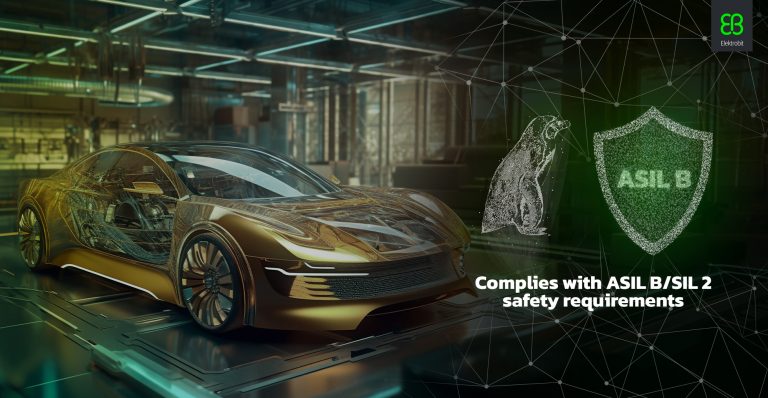
Built on the same foundation as our base OS, this variant adds ASIL B functional safety compliance and is delivered as a Safety Element out of Context (SEooC). While this page focuses on open-source contributions, our safety-certified variant extends the same philosophy into regulated environments – without compromising traceability or control.
To support early-stage development, we offer a free SDK download that allows teams to explore and prototype with EB corbos Linux for Safety Applications – before moving into safety-certified production.
EB corbos Hypervisor
ASIL B safety certified, microkernel-based open-source type-1, hypervisor.
A microkernel-based operating system with virtualization support. Its foundation is a variant of the open-source L4Re Operating System Framework maintained by Kernkonzept GmbH.
Ankaios
Open-source container and workload orchestrator for software-defined vehicles.
Elektrobit contributes to Ankaios, a lightweight, Rust-based embedded orchestrator under Eclipse SDV. It addresses the real-time, deterministic, and secure orchestration needs of modern automotive compute platforms.
Rust
Embedded modules to enhance memory safety, simplify concurrency, and increase resilience – especially in mission-critical areas.
ELISA stands for Enabling Linux In Safety Applications. It’s an open-source initiative under the Linux Foundation focused on facilitating the development and certification of Linux-based safety-critical systems—those whose failure could cause serious harm, such as injury, property damage, or environmental incidents. Rather than creating its own safe Linux distribution, ELISA unites industry stakeholders to collaboratively define and maintain tools, processes, and documentation that help developers demonstrate system safety compliance. The project also engages with safety standards bodies and certification authorities through its members’ expertise to shape industry practices.
The ELISA Project Working Groups focus on safety-critical challenges in using Linux, each focused on key areas such as tool investigation, software architecture, systems, automotive, safety use cases and more. Together, industry experts and leaders collaborate to build best practices, reference materials, and guidance that help make Linux a trusted component in safety-critical applications.
COVESA is an open, collaborative alliance focused on developing and advancing connected vehicle technologies. It brings together automakers, suppliers, and technology companies to define standards, share data models, and create interoperable solutions that enable new digital services. By developing common data approaches and technologies for connected vehicles and fostering a global ecosystem, COVESA helps accelerate innovation around in-vehicle experiences, connectivity, and cloud integration. Its work is a cornerstone for building scalable and sustainable digital services across the automotive industry.
The Eclipse Foundation is a leading open-source community that provides a vendor-neutral environment for collaborative software innovation. It hosts a number of strategic industry initiatives, including the Eclipse Software Defined Vehicle (SDV) Working Group, where automakers, suppliers, and technology leaders work together to accelerate the development of next-generation automotive software platforms. By fostering open collaboration and shared standards, the foundation helps reduce fragmentation, increase interoperability, and drive digital transformation across the mobility sector.
Automotive Grade Linux (AGL) is the leading open source platform for Software-Defined Vehicles (SDV), empowering automakers to deliver new features, updates, and user experiences over the air while accelerating the shift to software-centric vehicle architectures. AGL is a Linux Foundation Collaborative Project that unites automakers, suppliers, and technology companies to create a single, shared software stack for infotainment, instrument clusters, telematics, and other in-vehicle systems. By reducing fragmentation and fostering collaboration across the industry, AGL speeds development and time to market, driving innovation at the heart of the connected and software-defined vehicle ecosystem.
JasPar is a consortium of numerous Japanese automobile manufacturers and suppliers with the goal of promoting automotive software technology and reducing development costs. With this in mind, Japanese companies are encouraged to jointly develop technologies such as automotive LAN-enabled technologies, middleware, and software platforms. JasPar represents the Japanese automotive industry in international standardization bodies and contributes to the development of global standards. Elektrobit is a regular member of the JasPar.
SOAFEE is an industry-led collaboration that brings proven methodologies together with standardized interfaces and deployable open-source and commercial Blueprint building blocks. It enables automotive software developers to create portable, software- and AI-defined solutions that run consistently across vehicle platforms.
SOAFEE works with other industry consortia such as AUTOSAR to showcase how AUTOSAR-based applications can be built and deployed within a SOAFEE environment. Another key initiative SOAFEE supports is enabling safety-critical applications running on Linux, including solutions such as EB Corbos.
Through its global ecosystem of members, SOAFEE connects leading technology suppliers, OEMs, and Tier-1s to develop and validate standardized interfaces in SOAFEE Blueprints – simplifying integration, reducing duplication of effort, and accelerating time to production.
SOAFEE: Driving Software That Moves.

The Linux Foundation is dedicated to building sustainable ecosystems around open-source projects to accelerate technology development and commercial adoption.
Founded in 2000, the Linux Foundation provides unparalleled support for open-source communities through financial and intellectual resources, infrastructure, services, events, and training. Working together, the Linux Foundation and its projects form the most ambitious and successful investment in the creation of shared technology.
Elektrobit is member of the Linux Foundation projects ELISA and AGL.

The Eclipse Safe Open Vehicle Core (Eclipse S-CORE) project develops an open-source core software stack for Software Defined Vehicles (SDVs), with a focus on high-performance embedded Electronic Control Units (ECUs). Designed for safety-critical applications, Eclipse S-CORE ensures compliance with key automotive safety and cybersecurity standards, including ISO 26262 (functional safety), ISO/SAE 21434, and UNECE WP.29. By providing a reliable and standards-aligned foundation, the project enables organizations to build and validate next-generation automotive software with confidence.
As a member of the Eclipse S-CORE project, Elektrobit has made its EB corbos Linux for Safety Applications available within Eclipse S-CORE, allowing interested parties to integrate and evaluate their applications in a safety-compliant Linux environment.
Start creating with us – your open-source future begins now

Start developing
Cloud-ready, customizable software package complete with an SDK, tooling, and source code.

Webinars
Learn from our experts about open source, SDV, and safety compliance.

Tutorials
Start developing with EB corbos Linux.

Join the community
Elektrobit on GitHub, free open-source infrastructure to share codes.
Related content